Classics of Moral and Political Theory by Morgan Michael L
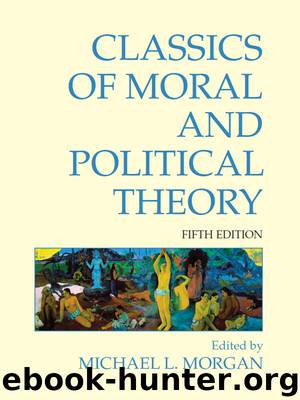
Author:Morgan, Michael L.
Language: eng
Format: epub
Tags: ebook, book
Publisher: Hackett Publishing Company, Inc.
Published: 2011-12-15T16:00:00+00:00
JOHN LOCKE
A number of recent interpretations of the political writings of John Locke (1632–1704) situate them in the context of the Exclusion Controversy of 1679–1683 and the Glorious Revolution of 1688–1689. This portrait of Locke as a radical activist reminds us that his political and religious writings, like those of Hobbes before him, are intimately associated with the turbulent events of seventeenth-century England. His discussions of toleration, property, civil authority, rebellion, and much else are not detached reflections on perennial themes; rather, they are engaged contributions to real political debate and concrete events. Yet, while these events occasioned many arguments in the Two Treatises, it is equally true that Locke was dealing with problems of the origin, extent, and limits to government that were central to political thought in England and Europe since the 1620s and remain central today. Moreover, as with his predecessors, his thinking reverberated well beyond these boundaries, especially in the next century in America, where his account of property, his argument for political obligation, and his justification for the right of a people to rebel against an oppressive government were widely cited in the years preceding the American Revolution. Locke, then, was both a living and a posthumous revolutionary, a defender of liberal government in his own world and in years and places far from his own. There is nothing belated about Locke’s importance to the tradition of Western political theory and philosophy.
Locke was born in Somerset in 1632, went to Westminster, an excellent school near London, and matriculated at Christ Church, Oxford, where, as Peter Laslett tells us, he was “urbane, idle, unhappy, and unremarkable.” Locke took a medical degree, in order to avoid the clergy, and studied philosophy. His interest in the science of his day continued throughout his life; in 1668 he was elected to the Royal Society, and he was a friend of Robert Boyle, Isaac Newton, Thomas Sydenham, and other figures central to the development of the new science. Like Hobbes, shortly after his graduation Locke became associated with a wealthy, powerful patron. Anthony Ashley Cooper, the first Earl of Shaftesbury, played a major role in Restoration politics and religious life. He strongly advocated toleration, vigorously opposed the threat of Catholic influence in England, and was a leader in the movement to exclude Charles II’s brother, James, a Catholic, from the line of succession to the throne. Locke became, first, Shaftesbury’s physician, then his research associate, coauthor, and political advisor. In the years of the Exclusion Controversy, Locke was active in Shaftesbury’s revolutionary group, and even during Shaftesbury’s imprisonment in 1680 and after his death in 1683, Locke continued his participation in this radical political movement.
In 1683, after the failure of the famous Rye House Plot to assassinate Charles II, Locke fled to Holland. There he played an active role in the community of exiled revolutionaries, negotiating transfers of funds, writing, and working in behalf of the aborted attempt to place the Duke of Monmouth on the throne. Prior to his
Download
This site does not store any files on its server. We only index and link to content provided by other sites. Please contact the content providers to delete copyright contents if any and email us, we'll remove relevant links or contents immediately.
| Anthropology | Archaeology |
| Philosophy | Politics & Government |
| Social Sciences | Sociology |
| Women's Studies |
The remains of the day by Kazuo Ishiguro(9003)
Tools of Titans by Timothy Ferriss(8402)
Giovanni's Room by James Baldwin(7351)
The Black Swan by Nassim Nicholas Taleb(7136)
Inner Engineering: A Yogi's Guide to Joy by Sadhguru(6798)
The Way of Zen by Alan W. Watts(6620)
The Power of Now: A Guide to Spiritual Enlightenment by Eckhart Tolle(5788)
Asking the Right Questions: A Guide to Critical Thinking by M. Neil Browne & Stuart M. Keeley(5778)
The Six Wives Of Henry VIII (WOMEN IN HISTORY) by Fraser Antonia(5518)
Astrophysics for People in a Hurry by Neil DeGrasse Tyson(5195)
Housekeeping by Marilynne Robinson(4453)
12 Rules for Life by Jordan B. Peterson(4308)
Ikigai by Héctor García & Francesc Miralles(4277)
Double Down (Diary of a Wimpy Kid Book 11) by Jeff Kinney(4276)
The Ethical Slut by Janet W. Hardy(4261)
Skin in the Game by Nassim Nicholas Taleb(4255)
The Art of Happiness by The Dalai Lama(4132)
Skin in the Game: Hidden Asymmetries in Daily Life by Nassim Nicholas Taleb(4011)
Walking by Henry David Thoreau(3966)
